
Across the legal industry, the pace and nature of change are evolving. Advances in technology, increased consolidation, shifting client expectations, and new career dynamics are reshaping how we work. Many of these developments are not entirely new, but they are occurring simultaneously and with greater visibility than in the past.
Industry data reflects this broader evolution. Law firm merger activity increased by 21 percent in the first half of 2025 compared with the same period in 2024, according to Fairfax Associates, as organizations sought scale, new capabilities, and strategic flexibility.¹ At the same time, technology advances are prompting leaders to think more creatively about structure, efficiency, and talent.
For those of us across the legal profession—partners, leaders, and talent professionals alike—this environment calls for a different kind of leadership. Not because the profession is in crisis, but because familiar playbooks are no longer sufficient on their own. Increasingly, leadership means guiding others through change thoughtfully, communicating with intention, and exercising sound judgment even when the full path forward is still coming into focus.
From VUCA to BANI: Why Leadership Feels Different
For many years, leaders described uncertainty using the VUCA framework: volatility, uncertainty, complexity, and ambiguity. VUCA assumed that while conditions might be turbulent, experience, planning, and analysis could still restore equilibrium. ²
What many of us are experiencing today feels different.
The BANI framework, introduced by futurist Jamais Cascio, offers a more useful lens for the current moment. ³ Rather than focusing on complexity alone, BANI captures how today’s systems and environments actually behave:
- Brittle: Systems that appear stable until they suddenly fail
- Anxious: Persistent unease driven by constant updates and incomplete information
- Nonlinear: Small actions producing disproportionate consequences
- Incomprehensible: Outcomes that defy intuition or past experience
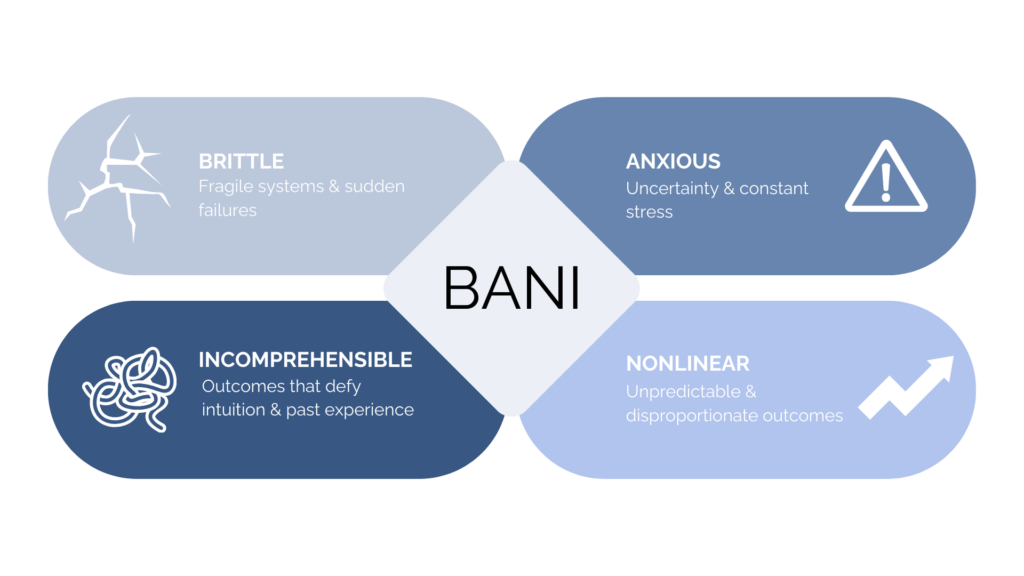
In a BANI environment, leadership is less about mastering complexity and more about maintaining coherence. The challenge is not just choosing the right answer, but sustaining trust, clarity, and alignment when certainty is limited and precedent is an unreliable guide.
This is where the idea of leading without a script becomes essential.
What People Watch When the Answers Are Still Forming
When clarity is incomplete, lawyers and professionals across the legal ecosystem do not disengage. They pay closer attention.
They watch:
- How decisions are made when information is partial
- Whether leaders explain their reasoning or simply announce outcomes
- How consistently change is communicated across roles and functions
- Whose perspectives are included, and whose are missing
- How leaders behave under pressure, disagreement, or scrutiny
These everyday moments create an implicit narrative about how leadership actually works. Over time, those lessons shape culture, influence trust, and affect whether people stay engaged or quietly pull back.
In periods of sustained change, behavior often carries more weight than messaging. When actions feel consistent and intentional, people can tolerate uncertainty. When they do not, speculation fills the gap.
What Leading Without a Script Actually Requires
Leading without a script does not mean improvising endlessly or projecting confidence without substance. It means being disciplined about how you lead when outcomes are still emerging.
Three practical shifts matter most.
1. Be explicit about how decisions are being made
In a nonlinear environment, people care less about perfect answers and more about understandable reasoning. Naming what is known, what is still evolving, and the criteria guiding decisions helps others make sense of change.
Clarity of process often matters more than clarity of outcome.
2. Create consistency in behavior, even as strategies evolve
Outcomes will shift. Timelines will change. What should not vary is how leaders communicate, follow through, and show up. Consistent leadership behavior becomes a stabilizing force when systems feel brittle.
When exceptions are necessary, explaining them preserves credibility.
3. Use talent partners as sense-makers, not just implementers
Talent professionals are often closest to how different cohorts and generations are interpreting change. Their insights can surface confusion, misalignment, or unintended consequences early, before disengagement turns into attrition.
In uncertain conditions, these partners are critical sources of perspective.
Culture Is Built When the Script Runs Out
Across the legal industry, we are adjusting in real time. Mergers and rapid technology adoption, among other factors, are reshaping how work is done and how careers unfold. In this context, culture is not something that lives only in values statements or strategic plans. It is built through repeated leadership behavior, especially when direction is still emerging.
Leading without a script means accepting that uncertainty is not a temporary phase to push through. It is the context in which leadership increasingly happens, and culture is forged.
- Fairfax Assocs., Law Firm Mergers Pick Up the Pace in 2025 (2025), https://www.fairfaxassociates.com/merger-reports/law-firm-mergers-pick-up-the-pace-in-2025-reports-fairfax-associates/.
- Nathan Bennett & G. James Lemoine, What VUCA Really Means for You, 92 Harv. Bus. Rev. 27 (Jan.–Feb. 2014).
- Jamais Cascio, Bob Johansen & Angela F. Williams, Navigating the Age of Chaos: The Essential Guide to Improving Your Organization’s Agility and Resilience (Penguin Random House 2024).