
Law firms have invested heavily in formal development programs: structured onboarding, skills curricula, mentoring initiatives, and competency frameworks. Many have also recognized that the legal profession is at an inflection point, and have begun asking hard questions about whether their development infrastructure is keeping pace with the way legal work is actually changing. The firms doing that work now are well positioned to build something more deliberate, more consistent, and more effective than the system they inherited.
For decades, lawyer development has operated through an apprenticeship system, often reinforced by formal training. Junior lawyers learned by proximity. They absorbed judgment by watching it applied in practice. They received correction in the moment. They understood where they stood because they were close enough to read the signals. The apprenticeship layer provided texture, context, and the kind of judgment that cannot be taught in a classroom; formal programs reinforced and structured what the day-to-day work was already producing. Together, they worked.
Three forces are now dismantling that apprenticeship layer simultaneously. Artificial intelligence is absorbing the entry-level work that once served as the training ground: the research, the first drafts, the document review. Hybrid and distributed work structures have weakened the day-to-day proximity that made informal learning possible. And multiple generations are working together with genuinely different assumptions about what good development looks like, and misreading each other as a result.
AI and generational change are dismantling the informal conditions that made lawyer development happen as a byproduct of proximity and shared experience. That is an invitation to build something better. The apprenticeship layer, when it functioned well, functioned variably: it worked for lawyers who were in the right room with the right partner at the right moment. Intentional development, built to complement and reinforce formal programs, can work consistently. It requires, however, a different set of habits.
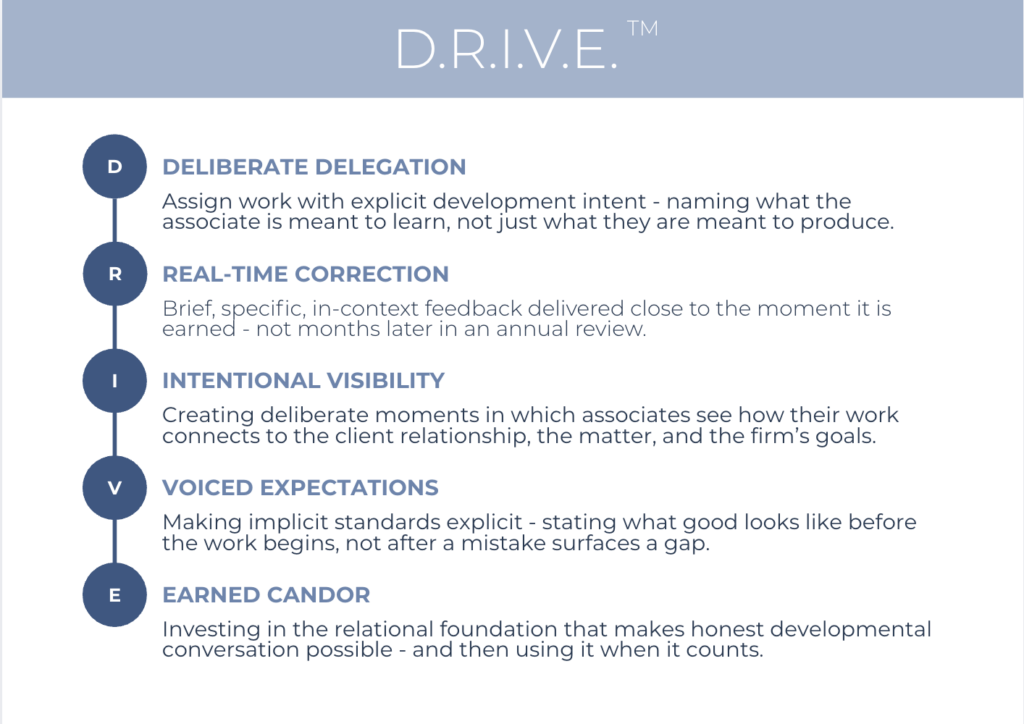
In my work coaching and advising law firm leaders, I have identified five practices that distinguish firms navigating this transition effectively. Together, they form the D.R.I.V.E.™ Framework, a set of behaviors that, taken together, rebuild the developmental trust that the apprenticeship layer provided informally alongside structured training.
D: Deliberate Delegation
In the traditional model, delegation was transactional: here is the task, return it when it is complete. In an intentional development model, delegation serves a second purpose.
Deliberate delegation means assigning work with explicit developmental intent, naming what the associate is meant to learn from the assignment and not only what they are meant to produce. This takes approximately ninety seconds. It changes the nature of the experience entirely. An associate who understands that they are being assigned a client memorandum in order to develop their ability to synthesize complex issues for a non-specialist audience will approach that assignment differently from one who understands only that the work needs to be done.
As AI absorbs more of the mechanical dimensions of junior work, deliberate delegation becomes the primary mechanism through which partners can ensure that the work that remains is genuinely developmental, and that it connects meaningfully to the firm’s formal training investments.
R: Real-Time Correction
From a developmental standpoint, the annual review has significant limitations when it stands alone. Feedback delivered months after the relevant moment cannot change behavior in any meaningful way.
Real-time correction means brief, specific, in-context feedback delivered close to the moment it is warranted. A five-minute debrief following a client call. Two sentences after a draft is returned. A brief observation after a negotiation. These interactions do not require scheduled time. They require intention: the habit of noticing, and the willingness to say something.
This is the area where generational friction most consistently surfaces. Partners who learned through immersion and in-the-moment correction often assume their standards are apparent to the people working for them. In most cases, they are not. Naming those standards, briefly and specifically, in the moment is not excessive accommodation. It is what makes formal training land in practice.
I: Intentional Visibility
One of the quieter forms of developmental trust erosion is invisibility: the experience of completing work that disappears into a matter without acknowledgment, without context, and without any indication that it was read or considered.
Intentional visibility means creating deliberate moments in which associates understand how their work connects to the client relationship, the matter strategy, and the broader goals of the team. It means involving associates in conversations they would not otherwise attend, not as passive observers but as participants with a defined role. It means ensuring that the people doing the work are able to see its impact.
This is what proximity once provided alongside formal programs, translating classroom learning into lived experience. In a hybrid, distributed environment, it must be engineered.
V: Voiced Expectations
Partners frequently assume that their standards are evident from context. They are not. What presents as underperformance is often a failure of communication: an associate working diligently toward a target they are unable to see.
Voiced expectations means making implicit standards explicit before the work begins rather than after a problem surfaces. What does strong work product look like on this matter? What does this client prioritize? What does this partner consider essential? What does progress look like at this stage of a career? Stating the answers to those questions in advance is not superfluous; it is efficient, and it gives formal development investments a clear context in which to take root.
This practice has a disproportionate effect at the senior associate level, where the questions that matter most, whether the associate is on track and whether there is a future for them at the firm, are least likely to be raised directly and most likely to be resolved by inference from silence.
E: Earned Candor
Candor without trust registers as criticism. Trust without candor registers as indifference. The fifth practice is the one that holds the others together.
Earned candor means building the relational foundation that makes honest developmental conversation possible, and then using it when the moment calls for it. It means following through on commitments consistently. It means giving credit where credit is due, and doing so visibly. It means that when a difficult conversation is required, having it directly rather than moderating it into ambiguity.
This is not a secondary consideration. In a profession where the cost of a misaligned senior associate is measured in years of investment, including the firm’s investment in formal training and development, the capacity to conduct a candid developmental conversation is among the highest-leverage skills a partner can develop.
None of these practices require a very significant investment of time. All of them require intention. Taken together, they restore the apprenticeship layer that formal programs were always designed to work alongside, and they create the conditions in which developmental trust accumulates, in which associates experience their firm as genuinely invested in their growth, and partners experience their teams as genuinely engaged in the work.
The disruption AI creates is real, but so is the opportunity it presents. Firms that invest in rebuilding the informal layer of development, deliberately and consistently, are not simply responding to change. They are building the kind of culture that attracts and retains the lawyers they most want to keep.
Later this month I am releasing a white paper, From Erosion to Opportunity: Advancing Lawyer Development in the AI Era, which examines these issues in depth, including the forces dismantling the apprenticeship layer, the trust deficit they are producing, and the practices that can address it.